STEP 01
Pick your critique and pay
Choose the critique that fits below and check out — secure checkout through Stripe, starting at 99¢. Takes about a minute.

PXL8IT Productions — Ocala, Florida
What works, what doesn’t, and the one fix that matters most. No score from an algorithm, no generic praise — an award-winning photographer’s read on your work, written out and emailed to you.
Critiquesfrom $0.99
The five things every critique is built on. Not a checklist we rush through — the order we actually read a photograph in.
Every critique follows the same shape. First, we name what you did well by its technical name — we call the actual techniques in your photo what they are. Then we cover the technical aspects honestly: what’s working, what isn’t, and why. Then we tell you the overall feeling the photo gives a viewer — because a technically perfect photo can still feel dead.
How it’s used, where it fights the photo.
Whether the frame caught the real one.
Depth, foreground to background — layering and depth that give a flat frame somewhere to travel.
What the frame rewards on a second look — named by the technique itself: rule of thirds, leading lines, golden ratio, symmetry, framing, negative space, and layering/depth. If you used it, we name it. If you broke a rule on purpose and it works, we say that too.
Where you stood, and whether it was the right place.
Three steps, in this order. No account, no app, no portal to learn.
Choose the critique that fits below and check out — secure checkout through Stripe, starting at 99¢. Takes about a minute.
Once your payment goes through, you’re redirected straight back to this page — no hunting for links, nothing to keep track of. You’ll land at the upload step below.
Click the upload button and your email app opens with our address already filled in. Attach your photo file, hit send, and you’re done — your written critique comes back to that same inbox inside your tier’s turnaround. What works, what doesn’t, and what to change first.
Every tier is a written critique by email. The difference is how many photos, and how deep we go. Once you’ve paid, you’ll be redirected right back to this page — and that’s where you send us your photos.
Emailed within 48 hours
Critique my first photo — 99¢After you pay, you’ll be brought right back here to send your photo
Emailed within 48 hours
Get the Quick Critiques — $9.99After you pay, you’ll be brought right back here to send your photo
Emailed within 72 hours
Get the Deep Dive — $49After you pay, you’ll be brought right back here to send your photos
Emailed within 5 days
Get the Portfolio Review — $149After you pay, you’ll be brought right back here to send your photos
Your photos stay 100% yours. We don't own them, post them, or share them — we just critique them.
All checkout is secure through Stripe. After you pay, Stripe brings you right back here to the upload step below — that’s where you send your photos to us.
You’re back — your payment has been completed, and this is the easy part. Click the button below and your email app opens with our address already filled in. Just attach your photo file and hit send. Send it from the same email address you used at checkout — that’s how we match your photos to your payment.
Put your tier name in the subject line, and send full-size files, not screenshots. Your critique comes back to that same email address inside your tier’s turnaround.
Every image you submit remains 100% yours. You keep the full copyright and every right you had before you sent it — submitting a photo for critique transfers nothing to us and grants PXL8IT Productions no ownership, license, or usage rights of any kind. We use your images for one thing only: preparing and delivering your critique. We do not publish, post, sell, license, or share them, and they are never used to train AI models.
Our guarantee
“If a critique doesn’t hand you at least one thing you’ll actually change, the next one’s free.”
That’s the whole deal. If we can’t show you something worth changing, we didn’t do the job.
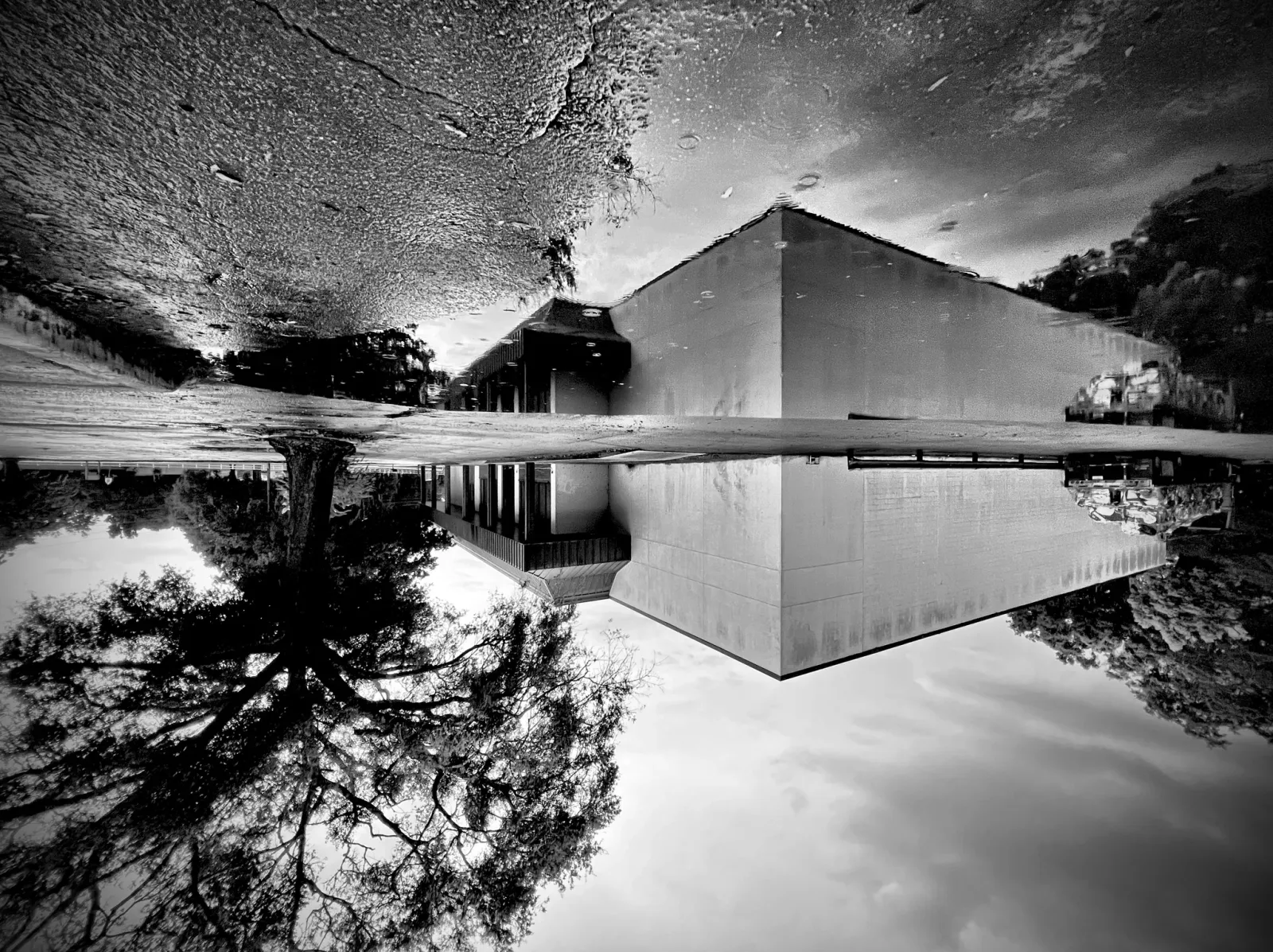
This is the photo from the top of the page, read the way we read yours — all the way through, not the short version. This is the depth the Deep Dive and Portfolio Review tiers get on every photo.
First thing: this photo knows what its trick is, and the trick works. You shot a plain concrete building in a puddle and flipped the frame, so the wet asphalt sits on top, the sky sits at the bottom, and the building hangs in the middle like it’s floating. For the first two seconds we don’t know which half is real — and those two seconds are the whole photograph. Everything good here comes from that decision. Everything that holds it back comes from stopping there: once we sort out the flip, the frame doesn’t give us much more to find. It’s a strong idea, honestly seen, that needed another five minutes of working before you walked away.
What works, and why: the symmetry of the reflection, because doubling the building and the tree is what turns a plain scene into the photo’s idea. The leading line of the seam — backed up by the roofline diagonal — because it gives our eye a route across the frame instead of leaving it to wander. The layering, because those three stacked textures create real depth in a flat parking lot. The flip, because it turns recognition into a small puzzle and buys the photo attention it hasn’t otherwise earned yet. The black-and-white treatment, because this image is about shape and texture — concrete against asphalt against leaves — and color would only describe the scene instead of sharpening it. And the restraint of the subject itself: one building, one tree, one puddle. Nothing here is accidental clutter that you chose; the frame is clean wherever you were in control of it.
What doesn’t, and why: the bright clutter at the far right, because the building’s corner drives our eye straight to that edge and there’s nothing there worth arriving for. The dead-center seam, because equal halves read as indecision — the photo can’t decide whether it’s about the building or its reflection, so it settles for both at half strength. And the heavy contrast in the edit, because the grain it adds to the sky and the asphalt starts to substitute for interest instead of supporting it. The scene had enough texture of its own.
One photo can’t prove a habit, but it can show a tell — and the tell here is a good one to know about. You clearly hunt for the graphic thing: reflections, symmetry, hard geometry, the frame inside the frame. That eye is real. The risk that comes with it is stopping at the first clever version. This reads like a photographer who found the flip, knew it worked, took it, and moved on — when the difference between this frame and a genuinely strong one was a few more minutes in the same spot: lower, tighter, working the seam up and down, waiting for the edges to clean up. You find interesting photographs. The next level is refusing to leave them at interesting.
The one fix: give the reflection the frame. Next time, drop the camera to within a few inches of the water and tilt until the seam between the building and its reflection sits in the top third of the frame, not the middle — put it on the rule-of-thirds line and let the symmetry work for one side instead of splitting the vote. The real building shrinks to a sliver that anchors the shot, the reflection — the building, the tree, all of it doubled and rippled — takes over, the heavy canopy moves out of its corner, and the clutter on the right leaves the frame entirely. One change of height fixes the balance, the point of view, and the edges at the same time.
Your drill: after the next rain, go back to one puddle — this one, if it’s still there — and shoot fifteen frames of the same building without moving your feet more than two steps in any direction. Change only the camera height, from standing down to nearly touching the water, one frame at a time. No editing until all fifteen are shot. Then lay them out in order and watch the seam travel through the frame. Pick the one where the reflection is unmistakably in charge. That frame — not the first one that worked — is the one you were actually there to make.
And after all the technicals, here’s what a viewer actually feels: a brief, pleasant disorientation, then a small letdown. The flip makes us stop and smile — the world turned upside down, a building floating in its own reflection. But once we’ve solved it, the feeling doesn’t deepen. There’s no quiet, no melancholy, no wonder that stays with us, because the frame is split so evenly and the edges are so busy that nothing is allowed to take charge emotionally either. That’s the gap in this photo, and it’s not a technical one. The technique is clever enough. What it needs is commitment — give the reflection the frame, and that first strange feeling might actually linger.
Learn what to look for in constructive photography feedback, from a full sample to the next change worth making.
Read Jason’s guide to choosing a photo critique service →